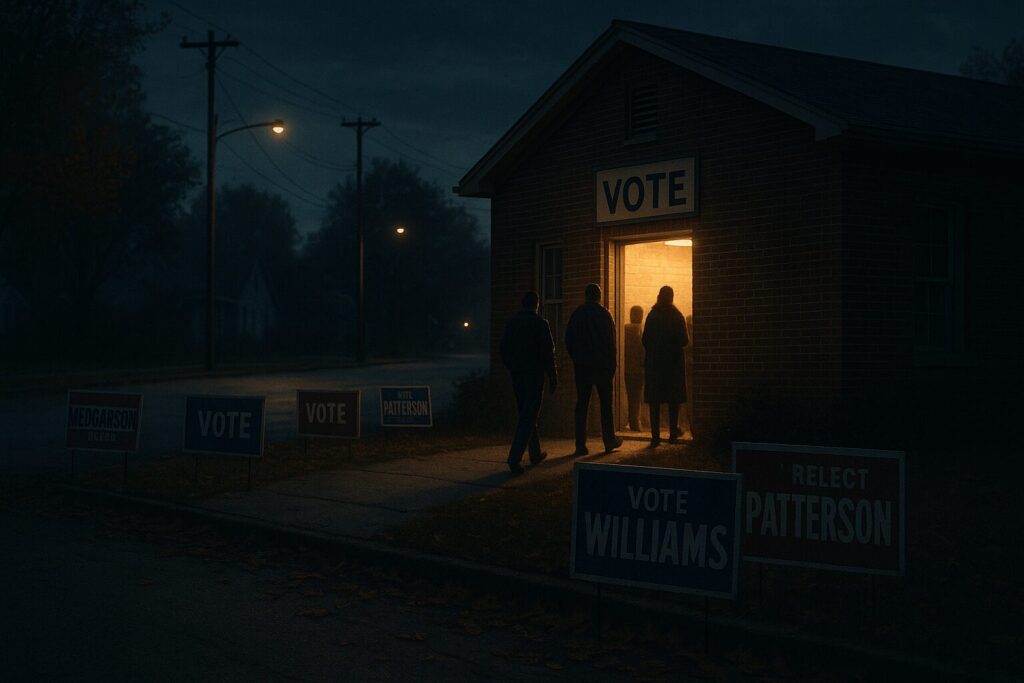
Today, across thousands of towns, Americans are voting, and most of the country has no idea it’s happening. City councils, school boards, bond issues, mayors, and millages. Ballots that fit in your hand but quietly shape the next decade of our lives.
We’re conditioned to think power changes hands on Election Night every two or four years, when the cable networks light up and the ticker scrolls across the bottom of the screen. But the real shifts, the ones that decide how communities grow, what kids learn, and which streets get fixed, happen right here, right now, in the elections almost nobody notices.
These are the elections where the future begins.
The Architecture of Attention
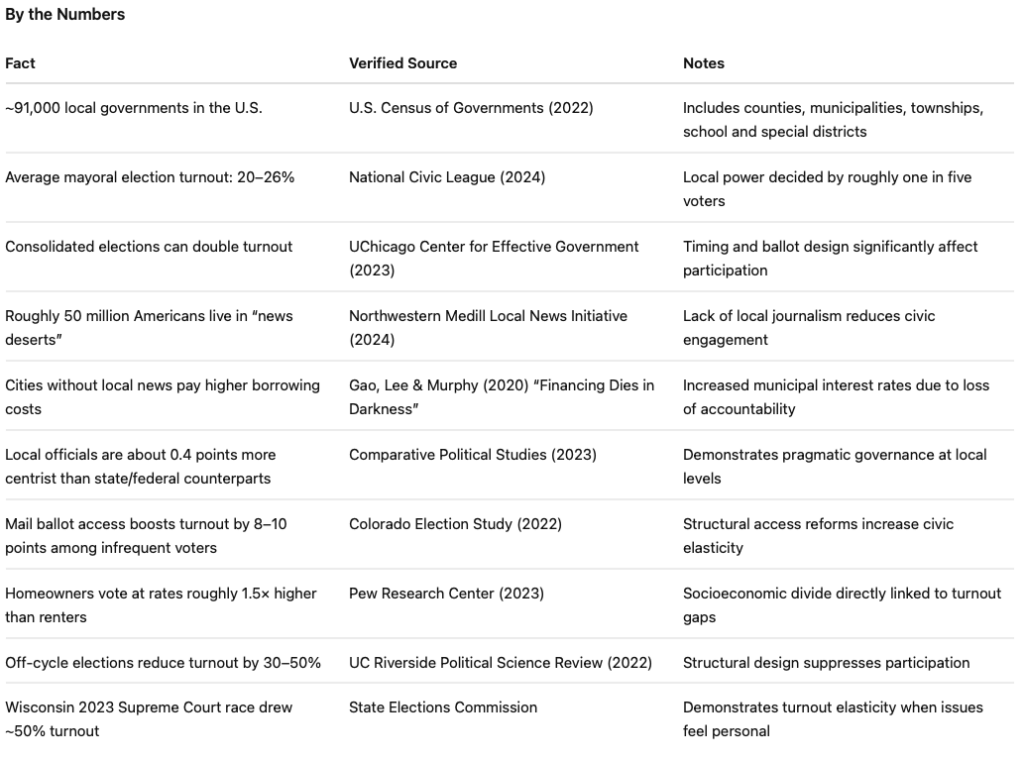
Every study confirms what we already feel: turnout isn’t driven by ideology; it’s driven by architecture. In most cities, only about one in five eligible voters participate in local races. That’s not apathy, it’s design. Off-cycle elections, buried ballots, and little to no press coverage create a system where the few who remember to vote hold the keys for everyone else.
When those same contests are moved onto higher-profile ballots, paired with state or federal elections, turnout doubles or even triples. Baltimore proved it when it aligned its local contests with presidential years. Los Angeles followed, rising from about 20 percent in 2017 to the mid-40s in 2022. San Francisco, like dozens of California cities, saw similar surges after the state’s consolidation law forced low-turnout municipalities onto major ballots. The pattern repeats everywhere: timing is destiny.
Ohio showed what happens when people are given something real to vote for. In 2023, a constitutional amendment on reproductive rights drove nearly half the electorate to the polls in what should have been an off-year. When the structure invites participation and the issue feels personal, the silence breaks. Democracy remembers how to breathe.
The Unequal Electorate
Here’s the quiet truth: the smaller the turnout, the narrower the electorate.
Homeowners vote at rates roughly one and a half times higher than renters. Seniors outvote young adults by seven to one. In many towns, the median age of local voters is more than fifteen years older than the community itself. It’s not that young people don’t care. It’s that they’ve been structurally designed out of power.
Local government bends toward whoever shows up. That means decisions on zoning, school budgets, and tax priorities are often made by a slice of the population that’s wealthier, older, whiter, and more insulated from economic volatility. The result isn’t just a civic gap; it’s a feedback loop. The people most affected by policy are the least represented in shaping it, and each cycle deepens that divide.
It’s the democratic equivalent of compound interest. Except here, the balance is power.
The Archetypes Emerging
Beneath the noise, three types of leaders are quietly rewriting the rules.
Post-Partisan Pragmatists like Yemi Mobolade in Colorado Springs prove you can win without a party label if you deliver results that people can see and touch. Their campaigns are built on competence, not culture wars. They remind people what government looks like when it works.
Community Populists, the neighborhood organizers, parent coalitions, and hyperlocal reformers, channel frustration into direct action. They come from the right and the left alike, united by a single sentiment: the system stopped listening. They’re loud, unpolished, and effective because they speak the language of urgency.
Technocratic Reformers, the fixers, planners, and administrators, rarely go viral, but they might be the most important of all. They don’t campaign on outrage; they campaign on outcomes. Their message isn’t “burn it down” but “build it better.” And quietly, that message is catching on.
Together, these archetypes point to something deeper: a hunger for function. A growing number of Americans don’t want ideological purity; they want proof of life from their institutions.
Don’t Be Distracted by the Show
Yes, there are marquee contests tonight. The 2025 New York City mayoral election has dominated headlines. Out west, California voters will weigh in on Proposition 50, a redistricting amendment that could redraw congressional lines and reshape representation for years. And in two states, gubernatorial races are testing the national temperature for both parties.
These are big stories. They attract the cameras, the pundits, the airtime. But they are the fireworks, not the fault lines. While we watch those races, the tectonic plates of American democracy are shifting quietly underneath, in city councils, school boards, and county commissions.
If you only follow the governor’s race or the redistricting fight, you’ll miss what’s happening closer to home. The new faces being elected tonight in city halls from Toledo to Tucson will decide the next chapter of American politics long before Washington does.
That’s how it always works. The energy behind movements, left, right, or center, rarely begins at the top. It starts at the bottom, in neighborhoods and networks that notice what the headlines miss. And if you don’t pay attention, you’ll wake up tomorrow thinking the only thing that mattered was who won New York. The truth is, the future was being written in a thousand smaller places while the cameras were pointed elsewhere.
The Collapse of the Watchdog
If turnout is the heart of local democracy, local news was once its pulse. That pulse is fading fast.
More than fifty million Americans now live in communities with no meaningful local reporting. Whole counties have become news deserts. Without that coverage, voters lose the connective tissue between their daily lives and the ballots in their hands. They stop knowing what their local government does, who’s running it, and how to hold it accountable.
The void doesn’t stay empty. It gets filled with something worse: national narratives and algorithmic outrage. Facebook groups and Nextdoor posts replace the newspaper. Rumor replaces reporting. And soon, a local school board debate about bus routes turns into a national culture war proxy.
The cost isn’t just civic, it’s financial. Towns without a local press pay more to borrow money because lenders see opacity as risk. Accountability has a credit rating, and when it vanishes, communities pay for it.
When the watchdog sleeps, accountability rots. And when accountability rots, participation follows.
The 2026 Rehearsal
These small elections aren’t isolated. They’re previews. Every turnout spike, every independent win, every new archetype emerging from city hall or a school board meeting is an early signal of what’s coming in 2026.
Registration data already tells the story. Since 2020, Democrats have lost about two million registered voters, Republicans have gained roughly the same, but the fastest-growing category isn’t either of them. It’s “No Party Preference.” In states like Arizona, Colorado, and North Carolina, independents now outnumber both major parties. The political middle isn’t dead; it’s reorganizing itself.
Local elections are the testing ground. They’re where voters try on new political identities before bringing them to the national stage. What we’re watching this week is a quiet rehearsal for a broader realignment, one built not on ideology but exhaustion.
The Math of Momentum
Civic scientists call it elasticity: how responsive a community’s turnout is to changes in access, timing, and trust. It’s the opposite of apathy. When structural barriers are lowered (mail ballots, aligned elections, better information) turnout rebounds fast. It’s proof that disengagement isn’t permanent; it’s conditional.
That’s the hopeful part of the story. Because it means this collapse isn’t destiny. It’s design, and design can change.
The Power of Small Elections
What’s happening today may look small, but it’s the raw material of the next political era. In the space between indifference and outrage, a new civic majority is trying to take shape, one that still believes in fairness, in competence, and in the simple idea that showing up should mean something again.
So if you’re one of the few voting today, one of those who still stand for a working democracy, understand this: your ballot weighs more than you think. Every line you fill in is a data point in the country’s next story. And one day soon, when the pundits start talking about a political realignment, they’ll be describing what began right here, in the year of small elections and big consequences.
Leave a Reply