
Every election season, we debate who really runs America. The billionaires. The lobbyists. The political machines. But the truth is simpler and more unsettling. America isn’t run from Washington. It’s run from the places most people ignore: town halls, school board meetings, county commissions. The quiet rooms where only a handful of people still show up.
While the nation’s attention is fixed on presidential debates and viral sound bites, local elections move in silence. A new mayor is chosen by twenty percent of voters. A school board race decided by two hundred ballots rewrites what kids learn. A zoning decision from a city council shifts the economy of an entire neighborhood. These aren’t side stories. They are the story of how power actually moves in America.
The myth is that politics happens “out there,” somewhere far away. But it’s the small, invisible elections that define whether a community thrives or withers. Democracy isn’t dying from polarization; it’s suffocating from neglect.
The Quiet Quorum
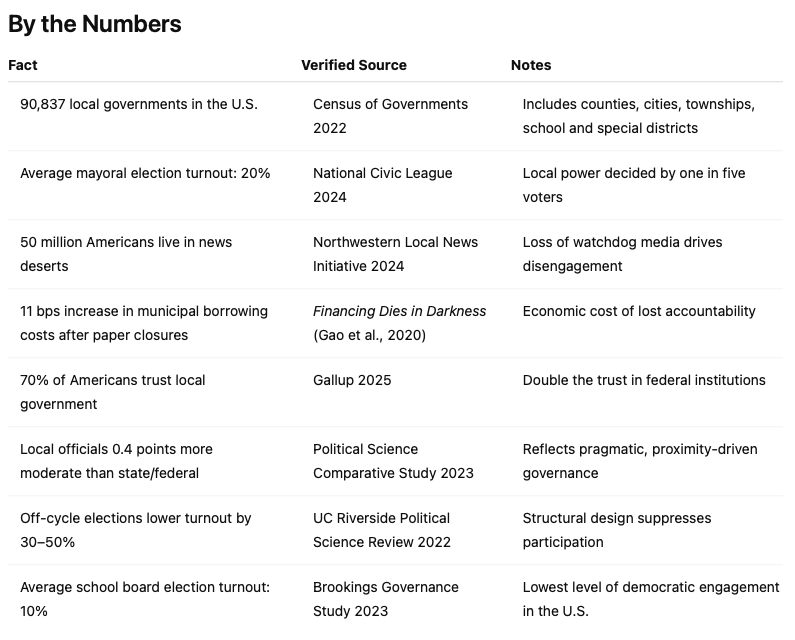
In most cities, one in five eligible voters decides who governs. In many local elections, turnout drops into single digits. School boards. County commissions. Special districts that manage everything from fire protection to water systems. Together, these tiny turnouts make up what might be the most powerful minority in the country.
They’re the quiet quorum, the few who show up while everyone else scrolls past. They decide budgets, policies, and priorities for entire communities. And the system quietly rewards them for it.
It’s not that people don’t care. It’s that the system makes them easy to forget. Off-cycle elections, buried ballots, and low coverage keep most Americans disengaged. The architecture of local power is designed for silence, and silence has consequences.
The Architecture of Absence
Off-cycle elections happen in months with no national races. They get little press, few campaign dollars, and even less turnout. When that happens, power shifts not to the public, but to whoever organizes first. A neighborhood group. A developer’s PAC. A motivated union. They don’t have to persuade a majority; they only have to outnumber whoever bothers to show up.
This isn’t an abstract theory. Studies show that school districts holding off-cycle elections are more influenced by organized interest groups. Teacher pay, for instance, runs about three percent higher than in districts that vote during major contests. That isn’t inherently bad policy, but it proves a deeper point: when few participate, organized groups fill the gap. Timing equals power, and silence decides who wields it.
And then there’s the local news collapse. More than three thousand newspapers have closed in the past two decades. Fifty million Americans now live in news deserts, communities with no meaningful local reporting. Without that watchdog, fewer people know who’s on their ballot or what those candidates stand for. When the lights go out, accountability goes with them.
It’s not just a civic loss. It’s economic. Cities without local journalism pay more in borrowing costs, up to eleven basis points higher on municipal bonds. “Financing dies in darkness” isn’t just a phrase. It’s fiscal reality.
Political scientists have a term for this quiet imbalance: Apathic Minoritarianism. It describes what happens when a majority with full power simply stops using it, and an active minority fills the space by default. It isn’t tyranny or conspiracy; it’s governance by vacancy. Power, left unattended, doesn’t disappear; it gets adopted by those who keep showing up.
The Power of Proximity
For all its flaws, local government still works better than the national one because it’s close enough to touch. You can meet your mayor at the coffee shop. You can see your tax dollars fixing potholes. You can attend a council meeting and speak directly to the people voting on your neighborhood’s future.
That proximity matters. Research shows that people who personally know a local official or attend a town meeting are far more likely to vote again. Trust builds when government is visible. And visibility breeds accountability.
Maybe that’s why local government remains the most trusted layer of democracy. Roughly seventy percent of Americans say they have at least some trust in their local officials, double the number who say the same about Washington. It’s not about ideology. It’s about familiarity. When you can see government work, you remember it’s supposed to.
The Pragmatists Still Standing
There’s another overlooked truth: local leaders tend to be more moderate. Measured across thousands of municipalities, local officials are about 0.4 points more centrist on a five-point ideological scale than their state or federal counterparts. They govern by necessity, not by ideology. When the water main bursts or the snowplows break down, there’s no time for partisan theater.
Local governance forces something the national system forgot: collaboration. School boards that blend conservatives and progressives still manage to balance budgets and improve test scores. City councils with mixed political leanings still build roads, repair bridges, and attract employers. Pragmatism isn’t a lack of conviction; it’s a survival skill.
That’s why For a Working Democracy invests locally. It’s not about partisanship; it’s about functionality. When fairness, stewardship, and standards are practiced on the ground, trust can scale up. But if local participation erodes, the center collapses, and with it, the foundation of democracy itself.
The Hidden Leverage of the Few
The irony is that the same small turnout that endangers democracy also holds the key to saving it. Because in a low-participation system, even modest engagement can have massive impact. A few hundred new voters can reshape a district. A few dozen volunteers can change who gets elected. When the minority chooses to act differently, they become the reformers instead of the gatekeepers.
That’s the paradox of local power: the fewer who vote, the more each vote matters. For those willing to show up, the system is wide open.
The Week That Matters
Next week, cities and towns across America will hold elections that most of the country will never notice. Mayors. School board members. City councils. The people who make the decisions we actually live with.
Most won’t vote. They’ll assume democracy happens in November of a presidential year or at the very least during midterms. But for the people who do, next week is everything. Their ballots won’t trend. They won’t go viral. But they will decide which streets get fixed, which schools stay open, and which voices carry the most weight in the places we all call home.
If democracy survives, it won’t be because Washington learned how to compromise. It’ll be because ordinary citizens remembered they still had the keys and started using them again.
The ballots waiting next week aren’t small. They’re the blueprint for who’s really running America.
Leave a Reply